April 12, 2026 • Cara Whitfield • 9 min reading time • Prices verified June 4, 2026
All-Metal Handheld Shower Heads: Why the Housing Material Changes More Than Just the Look
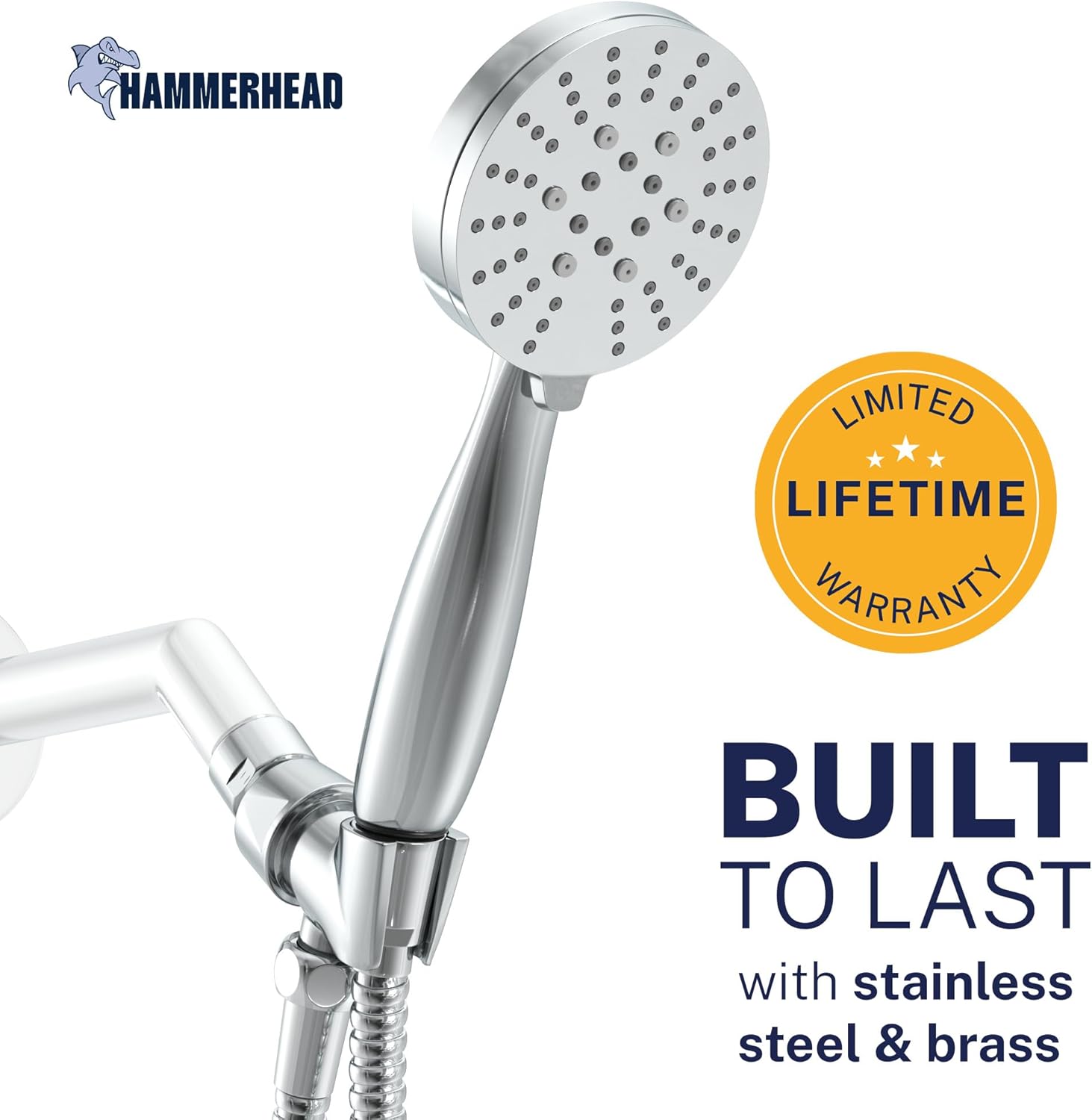
Pick up a builder-grade handheld shower head — the kind that comes standard in most new construction — and it will feel light in your hand, almost toy-like. That’s not an accident: the housing (the outer shell that holds all the working parts together) is almost always made from ABS plastic, a rigid polymer that’s cheap to mold and fast to manufacture. Now pick up an all-metal handheld — one with a solid brass or zinc-alloy body — and the difference is immediate. It’s heavier, it feels planted when you dock it, and the finish sits differently under light. What you’re holding is a different category of product, not just a prettier version of the same thing. This guide explains what “all-metal” actually means on a spec sheet, why the housing material affects pressure delivery and longevity in ways that go well beyond aesthetics, and how to match the right construction tier to your specific renovation goal — whether that’s a long-term master-bath install or a mid-range upgrade you want to last a decade without re-buying.
| EDITOR'S PICK[Speakman S-2252 Signature Icon…](https://www.amazon.com/dp/B004XA284E?tag=greenflower20-20) | Mid-tier[HammerHead Showers® Solid Metal…](https://www.amazon.com/dp/B077GHJFLP?tag=greenflower20-20) | Budget pick[G-Promise Handheld Shower Head…](https://www.amazon.com/dp/B08SJX9L39?tag=greenflower20-20) | |
|---|---|---|---|
| Housing material | Solid brass | Solid metal | — |
| Flow rate (GPM) | 2.5 | 2.5 | — |
| Spray settings | — | — | 6 |
| Hose length | — | 6 ft | — |
| Bracket included | — | ✓ | ✓ |
| Finish | Polished Chrome | CHROME | Chrome |
| Price | $140.30 | $99.95 | $47.19 |
| See on Amazon → | See on Amazon → | See on Amazon → |
What “All-Metal” Actually Means (and What It Doesn’t)
The phrase “all-metal” on a product listing is doing real work — but it’s not perfectly standardized, and that creates traps for informed buyers.
Solid brass is the benchmark. Brass (a copper-zinc alloy) machines well, resists corrosion without surface treatment, and takes PVD (physical vapor deposition) and electroplated finishes at a molecular level. When Hansgrohe or Grohe describes a handheld body as brass, they typically mean the main housing, the face plate, and the connection collar are all cast or machined from that alloy. The internal flow channels may still include plastic inserts — nozzle faces are almost always a silicone or thermoplastic elastomer — but the structural skeleton is metal throughout.
Zinc alloy (sometimes labeled Zamak, after the industry trade name) is lighter and less expensive to cast than brass, and is common in the $80–$180 tier. It’s not a bad material — it holds finish well and machines cleanly — but it is more vulnerable to corrosion at threaded joints over time, particularly in water with high mineral content. Reviewers at Bob Vila’s buying guides note that zinc-bodied fixtures occasionally show finish bubbling or joint weeping after five to eight years in hard-water markets, while brass equivalents in the same conditions typically don’t.
“Metal-accented” or “metal-finish” is a different claim entirely. These units have a plastic housing with a chrome or brushed nickel coating applied over it. They can look nearly identical to true-metal units in a showroom. The tells: they’re significantly lighter, the finish is thinner and more prone to chipping at impact points, and the threaded connection at the hose fitting is plastic internally — which can crack under overtightening or thermal cycling.
By the numbers:
- Solid brass handheld: typically 10–16 oz body weight (unhoused)
- Zinc alloy handheld: typically 7–11 oz
- ABS plastic with chrome coating: typically 3–6 oz
- Rated service life (manufacturer warranty as a proxy): brass units, 5–10 years; plastic units, 1–3 years at most major brands
This Old House’s editorial guide on shower head selection explicitly flags the weight test as a reliable field heuristic: a genuinely metal-bodied handheld will feel noticeably heavier than its plastic-shelled counterpart at the same size.
How Housing Material Affects Pressure Feel and Spray Consistency
Here’s the counterintuitive part that most buyers miss: the housing material influences how the spray actually feels in use — not just how long the unit lasts.
The reason is dimensional stability. Brass and zinc alloy maintain tighter manufacturing tolerances than plastic, and they don’t flex under pressure changes the way ABS does. Inside a handheld shower head, water travels through a series of internal chambers and nozzle ports before exiting. In a rigid metal housing, those chamber dimensions stay consistent across the range of residential water pressures (typically 40–80 PSI). In a plastic housing, micro-flex under pressure variation causes subtle changes in port geometry — not enough to see, but enough that the spray pattern can feel slightly inconsistent between shower starts, or degrade gradually as the plastic fatigues.
Owners of Hansgrohe’s Croma Select E 110 — which uses a brass internal housing within its outer body — consistently report what they describe as a “dense,” stable spray character that doesn’t vary much whether they’re in a high-pressure urban apartment or a lower-pressure suburban home. That stability is partly the multi-function valve design, but it’s also partly the rigidity of the housing not deforming under variable inlet pressure.
The EPA’s WaterSense program, which certifies shower heads at or below 2.0 GPM (and now increasingly at 1.8 GPM for newer certifications), doesn’t directly address housing material — its mandate is flow rate. But the practical implication for metal-housing advocates is that at compliant low-flow rates, every incremental unit of water delivery needs to be used efficiently. A rigid housing with well-toleranced internal channels delivers that flow more consistently than a flex-prone plastic shell.
Architectural Digest’s roundup of designer-recommended shower fixtures notes that their interviewees specifically called out all-brass handhelds for “feeling more powerful than their GPM suggests” — attributing that perception to spray focus and pattern consistency rather than raw volume.
The Finish Equation: Why the Substrate Matters as Much as the Surface
If you’re specifying a brushed gold, matte black, or polished nickel handheld for a renovation — finishes that cost real money and need to last — the housing material underneath the finish determines whether that investment holds.
PVD (physical vapor deposition) coatings are the current gold standard for durability. They bond at the atomic level to the substrate and are highly resistant to tarnishing, corrosion, and the micro-scratching of daily use. Crucially, PVD performs best and adheres most durably over metal substrates — particularly brass. Applied over plastic, PVD is thinner and bonds less completely, making it more vulnerable to impact chips and finish lift at edges.
Electroplated chrome — the traditional method — also performs better over metal. The electroplating process actually requires a conductive substrate; plastic parts are given a chemical pre-treatment to enable plating, but the bond is weaker and the coating is thinner.
The practical implication: if you’re investing in a Polished Gold or Brushed Bronze finish at $250–$400+, a solid brass or zinc housing isn’t just an aesthetic preference — it’s finish protection. Family Handyman’s buyer guides on premium shower fixtures note that finish warranty length correlates tightly with housing material at the major brands: Hansgrohe and Grohe both offer lifetime finish warranties on their brass-bodied lines, while shorter 1–5 year finish coverage is more common on plastic-bodied fixtures from the same brands’ entry tiers.
Quick decision frame on finish investment:
- Matte Black or Brushed Gold over plastic housing → likely shows wear within 3–6 years in high-use applications
- Same finishes over solid brass with PVD → manufacturer-rated for 10+ years at most premium brands
- Polished Chrome over zinc alloy → middle ground; watch the threaded joints first
Matching Housing Tier to Your Renovation Scenario
This is where the tradeoffs crystallize into actual decisions. Here’s the “if X, then Y” framework:
If you’re doing a master-bath renovation you plan to keep for 10+ years: The all-brass tier is the defensible choice. Hansgrohe Croma Select E ($200–$280) and Grohe Rainshower SmartActive ($180–$320) both use brass-intensive construction and carry finish warranties that match the renovation timeline. The cost premium over plastic-bodied alternatives in the same spray-mode class is roughly $80–$140 — less than one plumber service call. Architectural Digest’s designer sources consistently land on Hansgrohe’s Croma and Select lines as the “last handheld you’ll buy for that bathroom.”
If you’re building a post-rehab or athletic-recovery shower station where pressure adjustability is the primary need: Speakman’s Anystream handhelds and Delta’s HydroRain series both offer metal-bodied options in the $120–$200 range with true multi-mode pressure adjustment. Owners in recovery-focused forums consistently cite the solid feel of the docking cradle and the hose fitting as factors in confidence during use — particularly relevant for accessibility retrofits where the unit is handled repeatedly and sometimes forcefully.
If you’re a first-time upgrader stepping up from builder-grade: The Moen Engage Magnetix ($60–$120) and Delta In2ition ($80–$130) are plastic-housed, which is appropriate for their price point. They’re not bad products — they’re correctly constructed for their tier. But if you’re asking whether to spend $40 more to reach a zinc-alloy-bodied unit in that range, the answer is generally yes, particularly if you’re in a hard-water market where threaded-joint corrosion is a real failure mode.
If the fixture is for a rental or a flip: Plastic-bodied chrome is defensible — it photographs well and holds up through a tenant turnover cycle. Spending for brass in that context returns less value. Bob Vila’s handheld roundups consistently place ABS-chrome units at the top of their “best value” tiers for exactly this reason.
One More Thing: The Hose and Collar Are Part of the System
An all-metal handheld paired with a plastic hose collar or a flimsy stainless-wrapped-over-plastic hose is a half-measure. The weakest point in a handheld system is almost always the connection at the shower arm fitting — the threaded collar where the hose meets the wall outlet. In metal-bodied units, this collar is typically brass or zinc; in plastic units, it’s often nylon or ABS.
Look for hoses rated at minimum 59 inches (the standard for comfortable reach), with solid brass swivel connections at both ends. Grohe and Hansgrohe include well-spec’d hoses with their premium handhelds; Kohler’s Artifacts series packages a compatible metal-collar hose as standard. If you’re buying a metal-bodied handheld from a secondary brand and the included hose has plastic swivel nuts, replace it — a quality all-metal hose in matching finish runs $15–$30 and completes the system properly.
The bottom line: all-metal housing is a structural decision that pays forward across pressure consistency, finish longevity, and system reliability — not just a weight premium for its own sake. Know what’s inside the shell before you commit to the finish on its surface.